
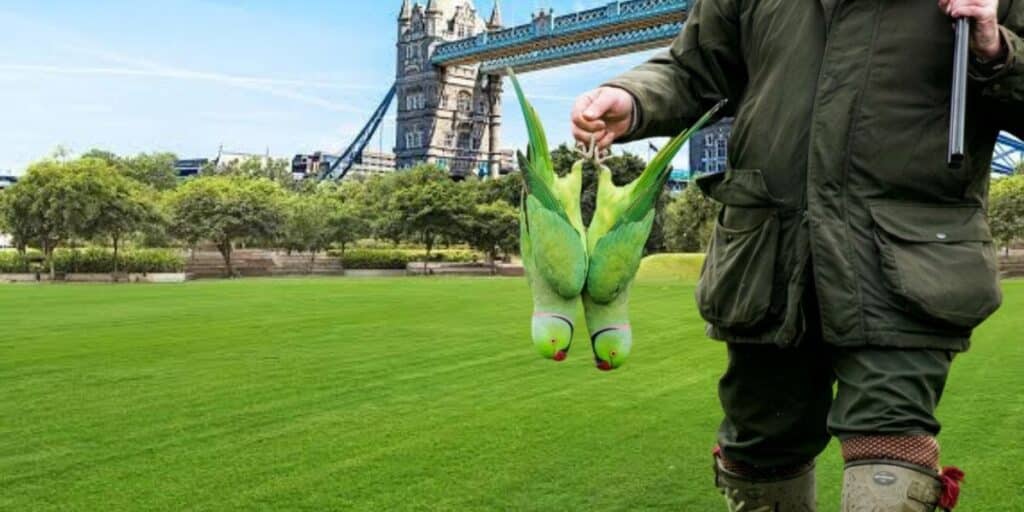
Yes, we’ve mocked up the header image, but back in March, BASC’s head of policy and campaigns urged members to flood a government consultation on amending the Wildlife and Countryside Act 1981 with calls for a long list of birds to be added to the so-called ‘quarry list’: a list of wild birds that can be hunted or shot during specified open seasons. In other words, for ‘sport’.
The government consultation was pitched by BASC as both a threat to shooting as well as an “opportunity” (change is always seen as a threat to shooting, and adding more birds to kill lists is always seen as an opportunity). BASC suggested (and we can only imagine the salivating the article will have induced in the armed hobbyist brigade) that the Ring-necked Parakeet should be added to the list, alongside the usual demonised corvids, including Carrion Crow, Jackdaw, and Raven.
Three months later, on 26 June, BASC published what was presumably meant to be a softer-edged feature on Britain’s “accidental wildlife” – the terrapins, wallabies, muntjac and Mandarin Ducks that largely owe their presence here to human carelessness (with no mention that the populations of Mandarins in Europe are increasing in striking contrast to the declines taking place across Asia where the duck originates).
And there, included among these ‘accidents’, was the Ring-necked Parakeet again.
With an apparent lack of irony, in their article BASC claimed that “Few birds divide opinion quite like the Ring-necked Parakeet”. Further down the same page they looked at the Ring-necked Pheasant, another non-native bird released into the countryside by the tens of millions every year by the very people the article would have been aimed at.
The imbalance was glaring. The parakeet is a genuinely wild bird that nobody manages, breeds without help, and asks nothing of anyone, was treated as a matter of controversy and thus fair game for the quarry list. The pheasant is bred in vast numbers on what our undercover investigations have led us to categorise as factory farms, fed by hand, and abandoned to the guns each autumn, but was credited with contributing to the “creation and management of valuable habitats such as woodlands and game cover” and delivering benefits to rural communities. Two birds: one pitched as good, one pitched as bad.
Both, as far as the shooter is concerned, should be shot dead anyway.

‘Management’
Before looking at the parakeets, let’s have a quick think about what habitat management for pheasants actually means in practice.
It means woodland edges and game cover managed to concentrate pheasants where they can be flushed and shot, not created for the benefit of native wildlife. It means predator control that strips woods and hedgerows of foxes, stoats, weasels and crows – not because they threaten anything rare, but because they threaten the shoot’s profit margin. Whatever incidental cover this provides for other species is a side effect of an industry built around killing, not evidence that killing is good for nature.
Compare that with the parakeet. Yes, it’s non-native, but its arrival here owes just as much to captivity and escape as the pheasant’s does. But there the similarity ends. Nobody breeds parakeets by the million and releases them each summer, or feeds them to keep them near the guns. They’ve built a wild, self-sustaining population in a landscape of parks, gardens and street trees that humans built for entirely different reasons, and they’re simply getting on with living in it.
And we – and BASC – should never forget that for a great many people, especially those living in cities, a flash of green and a screech overhead is perhaps their most reliable daily encounter with anything resembling wild nature.
Most people will never see flagship species like Curlews or Hen Harriers. Parakeets, on the other hand, turn up in gardens, on balconies, in local parks. They are visible and approachable. That matters. Some surveys suggest that UK children are among the most housebound in the world. Generations are growing up disconnected from nature. Yet research shows that spending time with nature lowers anxiety and depression, while fostering a sense of purpose and a deeper motivation to protect the environment.
Contact with nature – however it comes – is worth protecting. It’s certainly far better than destroying it for fun on a day out…

More scrutiny needed
None of this means parakeets are beyond scrutiny. There are legitimate concerns about competition for nesting holes with species like Starlings and Nuthatches, and those deserve proper research and monitoring. But “there might be a nesting-hole problem” is a world away from the case needed to justify a place on shooting’s ever-expanding ‘quarry list’.
The instinct to reach for the gun runs ahead of the evidence. Parakeets did not choose to be released into Britain any more than a pheasant did. But they are here, and like other species that shooting is determined to get listed for its own pleasure, they are simply trying to survive in a landscape we have increasingly modified to benefit ourselves.
Add the massive impact of climate change to the havoc we have already unleashed, and it’s getting to be a miracle that any wildlife survives in what is left of the ‘environment’ at all.
Frankly, we’re angry about this suggestion from BASC. Every consultation, every “opportunity” to add another species to the list of things it’s legal to kill, treats the natural world as something to be managed via the barrel of a gun rather than something to be lived alongside. A bird turning up in a garden and making people smile is not a problem that needs solving.
Anyone who looks at a parakeet and sees a live target rather than a fellow creature getting by has lost any real connection to the nature they claim to speak for.
And in our opinion, that disconnection should absolutely disqualify them from having any say in its future.

End Bird Shooting
Over the coming months our campaign will look at the shooting industry at every level. We will highlight the suppliers — the farms, hatcheries, importers and breeders producing tens of millions of birds under conditions that would provoke public outcry if applied to any other animal. We will expose the providers — the estates and syndicates that take those factory-farmed birds and sell the experience of killing them as leisure. And we will look at the clients — the paying guns who are fully aware of the wildlife crime, the trapping of native predators, and the mass suffering involved, and who have decided that none of it is reason enough to stay away.
This industry survives because suppliers supply, providers provide, and clients pay. We intend to examine them all.
- We are working to END BIRD SHOOTING. This suffering has to stop. Please share this article. Share our socials. Follow us for updates.